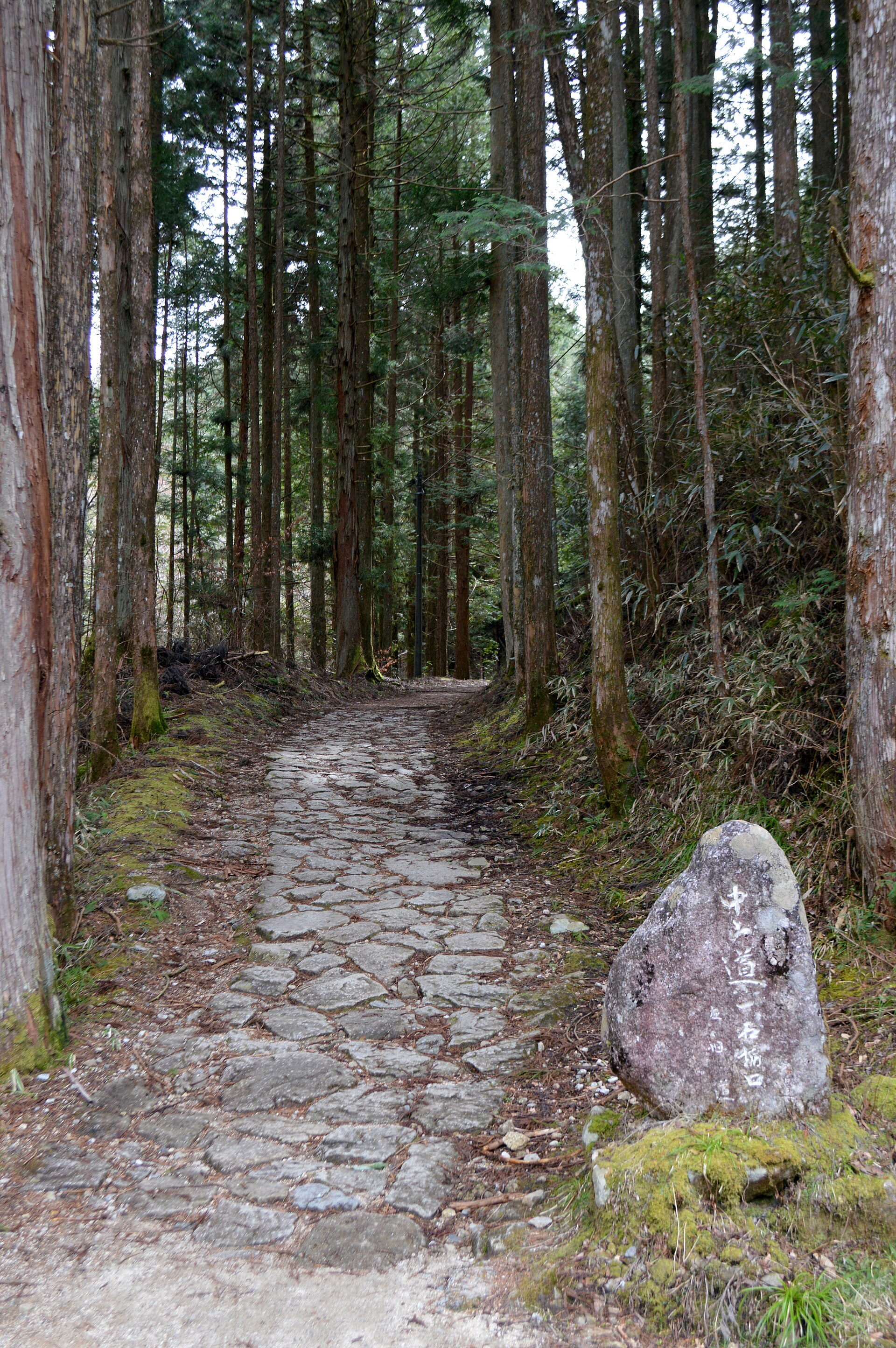
Of the 534 kilometres the Nakasendo once ran between Kyoto and Edo, this is the stretch everyone remembers: eight forested kilometres between two perfectly preserved post towns. It needs no guide to follow, the way is marked in four languages, but it rewards one. Here is the walk as it unfolds, with the details that turn a hike into a time machine.
Before you start: send the bag ahead
Both tourist offices (Magome's at the top of the street, Tsumago's mid-village) run a luggage-forwarding service: drop your bag in the morning, collect it at the other end after 13:00, for a few hundred yen. It operates daily in the main season (roughly late March to November, confirm at the counter), and it transforms the walk. Check the day's bus times too: the Magome-Tsumago bus shadows the trail, ready to rescue tired legs or rainy afternoons.
Km 0, Magome's stone ramp (allow 40 min before the trail)
Magome climbs its hillside in paved switchbacks of shops and teahouses, busiest at midday, lovely before 10:00. Walk up past the watermill, pause at the viewpoint where Mount Ena fills the sky, and stock up: gohei-mochi grilled on skewers, chestnut sweets (the Kiso speciality), water. The trailhead sign at the top of town reads Tsumago 8.0 km. Ring the first bear bell, they punctuate the route, half safety measure, half ritual, and go.
Km 2, The pass and the two trees
The climb to the Magome pass (801 m) is the walk's only real work: 30-40 minutes, partly beside the quiet road, gaining about 180 m from Magome. At the top, a stone marker, a teahouse-turned-rest-hut, and the border between Gifu and Nagano prefectures. The descent beyond belongs to the forest, and to the two 300-year-old sawara cypresses standing guard where the path re-enters the trees.
Trainers are fine, the path mixes stone paving, earth and short road sections. Bring a litre of water, rain layer (the Kiso brews showers), small cash for the teahouse box and vending machines, and in summer insect repellent. The trail is walkable year-round; after snowfall, ask at either tourist office before setting out, and in any season start no later than 14:30 to reach Tsumago in museum hours.
Km 4.5, Tateba teahouse: tea by donation, hearth included
Halfway down, smoke rises from the Tateba chaya: a volunteer keeps the irori hearth burning and pours mountain tea, free, as travellers have been received here for centuries. Sign the visitors' book, drop a coin in the box, and sit by the fire for ten minutes, this little room, more than any museum, is the Nakasendo still working. Shortly after, a side path (3 minutes) drops to the O-taki and Me-taki waterfalls, the "male and female falls" where Musashi is said to have trained. Take the detour; the cold spray is the walk's second gift.
Km 8, The street that receives you
The trail crosses the river, passes the first dark-timbered houses, and becomes Tsumago's main street without any boundary, no gate, no ticket, just the same road doing what it has always done. Arriving on foot, you understand the village differently than coach visitors ever can: the street isn't a museum of the highway, it is the highway. Collect your bag, check into your inn, and be on the street at 17:30 when the day empties and the lanterns take over.
Variations that work
Reverse direction (Tsumago→Magome) climbs longer but ends with Magome's viewpoint sunset, good if you sleep in Magome. Short on time: bus to the pass, walk down the best half to Tsumago (1.5 h). Hungry for more: the quieter Nagiso-Tsumago section adds 3.5 km of riverside path, and the northern Kiso towns, Narai above all, extend the Nakasendo by local train. However you cut it, keep the rule that makes this valley special: walk at Edo speed. The road was built for three weeks' travel; it can spare you three unhurried hours.